At Leeds University, I was working on the interface between two very different faculties, Arts (with Philosophy) and Science or Engineering (with Computing). This made me highly aware of the inconsistencies across the University, whereby students on interdisciplinary degree programmes could be treated very unfairly.
In 1992, the University started to think seriously about harmonisation of its degree classification procedures, which until that time had been evolving quite separately in each department. Within the Arts Faculty, a number of proposals were circulated, but these were mathematically defective or logically incoherent in various ways, as I pointed out to the Faculty Dean. He then invited me to try to come up with something better, whereupon I set about analysing the previous three years of classification data (all that were available on the central database), with the aim of producing a system which would be provably coherent while fitting as closely as possible with previous practice (across all faculties). The "Grade Score System" that I developed was duly accepted by the Arts Faculty, and operated from 1995 until 1999.
Meanwhile the other three faculties had come up with their own systems, all different, giving rise to some serious anomalies and injustices. These systems were mainly based on previous practice within particular departments rather than systematic design. And many of the loudest voices in the cross-faculty debate took their disciplinary tradition to be clearly correct, being very unwilling to consider alternatives. Hence the agreements within each faculty, which had been intended as stepping-stones towards a cross-university system, instead threatened to become obstacles to progress. A frustrated colleague, charged with giving a presentation on the topic, produced the following slide:
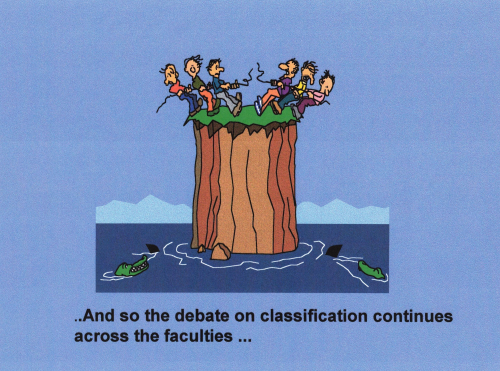
Then, in 1997, an impending external University Audit threw a spotlight on the Leeds classification systems, making their persisting inconsistencies a matter of considerable concern. Having based my own earlier work on a substantial cross-faculty analysis, I was in a good position to assist, and having been engaged to do this by the Pro Vice Chancellor for Teaching, was eventually able to persuade both the relevant University officials, and the Senate, to adopt a single classification system, which – with some modifications over time – has been in operation at Leeds since 2000 (having been formally adopted in 1998).
For a more detailed explanation of the system as originally designed, see:
- The Decimal Grade System of Degree Classification, prepared for the University Audit in 2000 (This has been cited in other publications on degree classification, including the "Burgess Group" report on Measuring and recording student achievement, commissioned by Universities UK)
The current version of the system is explained in a formal document on the University of Leeds website:
One day, it would be really interesting to analyse the data – ideally from other institutions also – and see the impact of this system (and the changes made to it) over time. One apparent result is that Leeds has avoided the massive "grade inflation" that has cast doubt on the credibility of degree classification at many other universities (as discussed, for example, in this BBC Report on Grade Inflation at Universities, from July 2019).
